Finding a Wedding Photographer in Hampshire: What Actually Matters
So you’re getting married in Hampshire. Congratulations! Now comes one of the most important decisions you’ll make for your big day: finding the right photographer. And honestly, it can feel a little overwhelming at first.
Here’s the thing most couples don’t realise until it’s too late. Your flowers will fade, your cake will get eaten, and your dress might only be worn once. But your wedding photos? Those stick around forever. They’re how you’ll relive that day for the rest of your life, so getting this decision right really does matter.
Whether you’re just starting your search or you’ve already fallen down a rabbit hole of Instagram profiles and pricing packages, this guide is here to help. Finding a great wedding photographer in Hampshire doesn’t have to be stressful once you know what to actually look for.
We’ve put together a straightforward list of the things that genuinely matter when making your choice. No confusing jargon, no industry fluff. Just honest, practical advice to help you feel confident booking the photographer who is truly right for you.
Why Documentary Photography Is Dominating Hampshire Weddings Right Now
Something has genuinely shifted in how couples talk about wedding photography. Not long ago, the default expectation was a full roster of posed shots: family groups in neat rows, the couple arranged in flattering light, everything polished and art-directed. In 2026, that conversation has flipped. The phrase you hear most often now is “less posing, more living,” and it captures exactly what couples across Hampshire and the wider South of England are asking for when they start reaching out to photographers.
The driving force behind this shift is what UK documentary photographer Simon Dewey described in English Wedding (January 2026) as the “anti-trend era.” The idea is straightforward but powerful: couples are choosing a style not because it looks great right now, but because it will still feel honest and emotionally real in five, ten, or twenty years. Heavily filtered, editorial-style images can feel iconic in the moment and oddly hollow a few years later. Documentary photography sidesteps that problem entirely, because the images are rooted in what actually happened rather than a visual trend that will eventually expire.
The data backs this up. According to Zola’s 2026 First Look Report, which surveyed more than 11,500 couples, 51% of engaged couples are now Gen Z, surpassing Millennials as the dominant demographic for the first time. This generation grew up with curated social media feeds and, perhaps because of that, has developed a strong instinct for what feels real versus what feels performed. Natural moments and genuine emotion consistently rank above traditional staged portraits in their priorities.
There is also a broader cultural conversation happening, particularly on social media, asking a genuinely uncomfortable question: is the modern wedding becoming about the photos rather than the people? The pushback against over-produced, heavily directed wedding content is growing, and it is creating a clear opening for documentary wedding photographers in Hampshire who can offer something different. As one Hampshire-based photographer puts it, the goal is for couples to be “present at your own wedding,” not managing a shoot.
Couples across Hampshire are responding to these national patterns in very practical ways. When they shortlist photographers, they are looking at galleries differently, asking not “does this look beautiful?” but “does this feel like a real day?” That question changes everything about how a documentary approach to wedding photography needs to be presented and why photographers who lead with authentic storytelling are increasingly the ones getting the enquiry.
What Documentary Wedding Photography Actually Looks Like on the Day
Think of a documentary wedding photographer as someone who arrives early and stays late, watching everything unfold rather than arranging it. A typical Hampshire wedding day, covered this way, might start in a getting-ready room at a country house near Winchester, where the real pictures are already happening: a mother doing up a zip with shaking hands, a best man reading his speech notes for the tenth time, a flower girl spinning in her dress while nobody is paying attention. These are the moments guests never see because they are not in the room. Your photographer is.
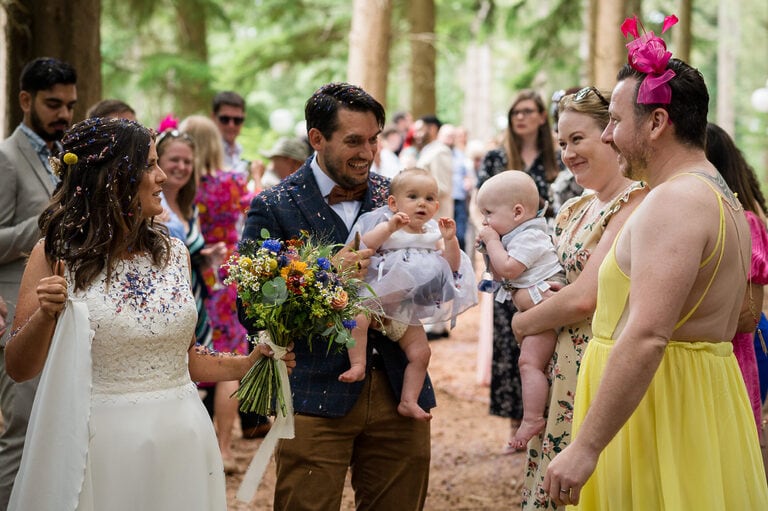
From there, the ceremony captures what no posed session ever could. The exact second a groom’s shoulders drop when he finally sees his partner walking down the aisle is gone in a fraction of a second. A documentary photographer is already positioned for it. Then comes the drinks reception, widely considered the richest hour of any wedding day, when guards come down, conversations spill onto the lawn, and small children find increasingly creative uses for the space under trestle tables. Speeches, first dance, the last hour when everyone stops performing and just enjoys themselves. All of it covered without a single “could everyone gather over here.”
Documentary, Reportage, Photojournalism: What Is the Difference?
Honestly, not much. These terms are often used interchangeably, and in practice they usually describe the same approach: the photographer responds to the day rather than directing it. Reportage has roots in press photography. Photojournalism is the same idea applied to weddings. Documentary has become the most common phrase couples use when searching for this style. If you have been searching all three, the underlying idea is identical. What matters is not which label a photographer uses, but whether their whole frame of reference is observational. Some photographers use “documentary” as a marketing label while spending most of the day arranging people. Their portfolio will tell you quickly which camp they are in.
Editorial is the one that genuinely differs: it is closer to a fashion shoot, with directed posing, styled lighting, and a polished magazine finish. Beautiful in its own right, but a different thing entirely.
The Portrait Misconception Worth Clearing Up
Documentary does not mean you will get zero couple photos. That is one of the most common misunderstandings worth addressing directly. What it means is that those portraits will not feel like stock images. A documentary photographer working with you for a few minutes near the afternoon light through a country house window is giving you gentle prompts, not choreographing you through a rigid sequence. The result looks like you, together, on your actual wedding day. Not a catalogue version of a couple.
How Hampshire’s Venues Shape the Light
Natural light is not just a technical preference; it gives documentary images their sense of place. The soft, directional light through old stained glass in a Hampshire village church feels completely different from the wrap-around warmth of a Georgian sash window at a country estate. A barn conversion near the New Forest has its own quality in late afternoon, golden and warm through wooden slats. Each Hampshire venue carries its own photographic character, and a photographer working exclusively with natural light is reading and responding to that rather than flattening it with flash.
This is the default approach for photographers like Nathan at Libra Photographic. It is not an optional extra or a style applied selectively between formal shots. It is how the entire day gets covered, from the first getting-ready frame through to the last song of the evening.
Hampshire Wedding Venues and What to Consider for Photography
Hampshire has some genuinely stunning settings for weddings, and each venue type brings its own photographic personality. Here is a quick look at four popular choices and what they mean for your photography.
Beaulieu sits within the New Forest estate and offers wide, open grounds flooded with natural light. For documentary photography, this kind of space is ideal. There is room to move freely, guests spread out naturally, and the relaxed atmosphere means candid moments happen constantly without anyone feeling watched or directed. A photographer can work quietly at a distance here and still capture everything.
Highclere Castle is a different kind of challenge in the best possible way. The grand interiors, sweeping staircases, and formal rooms are spectacular, but the light inside historic buildings can be tricky. Windows may be small, flash is often inappropriate aesthetically, and a photographer needs to work skillfully with whatever natural or ambient light is available. Outside, the facades and grounds offer something genuinely breathtaking, but knowing when and where the light falls well at different times of year makes a real difference to the results.
Sopley Mill is an intimate riverside venue where everything tends to happen close together. The compact layout, water features, and mill architecture create a naturally atmospheric setting, and the smaller footprint means a documentary photographer can be everywhere without ever being in the way. It is a venue that rewards patience and anticipation over direction.
Mercure Highfield Southampton brings an urban hotel context, with function rooms, corridors, and mixed light sources to navigate. This is not a limitation so much as a different creative puzzle. A photographer who understands how to use architectural framing and work with interior light will find genuine opportunities here, particularly during speeches, first dances, and the quieter in-between moments.
Why venue familiarity genuinely matters
Knowing a venue is not just a nice bonus; it changes how a photographer works. Someone who has covered a venue before knows where the light is flattering at two in the afternoon versus four, which corners of the grounds tend to produce the best natural moments, and how guests move through the space across a full day. That knowledge translates directly into stronger, more considered images.
Libra Photographic is based in Poole but covers Hampshire regularly alongside Dorset, building portfolio experience across both counties. That cross-county practice is genuinely useful: it means familiarity with a wider range of venues and light conditions than a photographer who only works one area. You get the benefit of that breadth without any compromise in the quality of coverage on your day.
When speaking to any photographer, it is worth asking directly whether they have worked at your venue before, and what that experience looked like. If they have not visited the venue yet, ask how they plan to familiarise themselves before your wedding day.
Libra Photographic also maintains a local venue guide covering Dorset and Hampshire, which is a helpful resource if you are still weighing up your options. It is worth exploring early in your planning, well before you have confirmed a venue, so you can factor photography conditions into your decision alongside everything else.
How Far in Advance Should You Book a Hampshire Wedding Photographer?
If you have a summer Saturday or a Bank Holiday weekend in mind, the honest answer is: start looking now. Popular Hampshire dates are booking out 12 to 18 months in advance for photographers with a distinctive documentary style, and that window is getting tighter. The 2026 planning landscape shows couples are locking in key suppliers earlier than ever before, which means if you wait until six months before your date to start searching, you will likely find that the photographers you love most are already taken.
The consequences of leaving it late go beyond just limited availability. When you book early, you get time to actually get to know your photographer before the day itself. You can do a pre-wedding shoot together, which is genuinely useful because it helps you relax in front of the camera and gives your photographer a feel for how you move and interact as a couple. Book late and you lose all of that. You also lose the flexibility to properly plan a timeline around natural light, which matters a lot in documentary photography where the goal is to capture real moments rather than manufacture them under artificial conditions.
A sensible approach is to start researching photographers at roughly the same time as you are looking at venues. Once your date is confirmed, aim to have your photographer booked within two to three months. When you reach out, treat the initial conversation as a two-way process. You are not auditioning them; you are both figuring out whether the fit is right. A good photographer wants to work with couples whose weddings they are genuinely excited about, and that enthusiasm shows up in the final images.
It is also worth knowing that when couples are asked how they allocate wedding budgets, photography consistently comes out as the category they protect most. Zola’s 2026 data backs this up, showing couples are cutting costs elsewhere before they reduce photography spend. That tells you something important: photographs are what you keep. Starting your search early means you are not forced into a compromise because your first choices are gone.
Finally, do not let geography become a reason to settle. Nathan Eames is based in Dorset, but shooting Hampshire weddings is a completely normal and regular part of the work. Travel is factored into packages, and the distance between Poole and venues across Hampshire is not a barrier. The right photographer for your wedding is the one whose work genuinely resonates with you, wherever they are based.
Three Questions to Ask a Wedding Photographer Before You Book
Once you have found a photographer whose work genuinely excites you, there are three questions worth asking before you sign anything. They are not the obvious ones about pricing or packages. They are the questions that reveal whether the photographer you are considering can actually deliver what you are hoping for.
“Can I see a full gallery from a single wedding, not just portfolio highlights?”
This is the most important question most couples never think to ask. A highlight reel on Instagram shows you the ten best images from ten different weddings, all shot in perfect light with perfect timing. What it cannot show you is what a complete day in that photographer’s hands actually looks like. For a documentary photographer, consistency across an entire day is the whole point. You want to see how they handled the dimly lit church ceremony, the chaotic confetti moment, the quiet ten minutes when the couple slipped away. Ask to see two or three full galleries from the past six to nine months, and look for a photographer who handles every part of the day with the same care, not just the golden-hour portraits.
“How do you handle low-light ceremonies, unpredictable weather, or a venue you have not shot at before?”
This question separates photographers who have only ever worked in favourable conditions from those with genuine technical depth. Hampshire weddings span everything from sun-drenched barn receptions to candlelit church ceremonies in late autumn, and the weather across southern England is rarely predictable. A confident, experienced photographer will give you a specific, honest answer here, including examples. They will talk about how they approach unfamiliar venues, how they read available light, and how they stay calm when the day does not go to plan. Vague reassurances are a red flag. Concrete examples are what you are listening for.
“What does the day look like from your perspective, and how involved will you be in directing us?”
The answer to this question tells you more about working style than any portfolio can. Some photographers run a wedding day like a fashion shoot, directing every frame. Others work almost invisibly, following the day rather than shaping it. Neither approach is wrong, but if you want natural, unposed coverage, you need a photographer whose instinct is to observe rather than orchestrate. Listen carefully to how they describe their day. Do they talk about moments they noticed, or shots they set up? The language they use will tell you a great deal.
One more thing: pay attention to the consultation itself
The conversation before you book is its own kind of test. Your photographer will spend more time with you on your wedding day than almost anyone else there, so the relationship genuinely matters. Notice whether they ask questions about you as people, whether they listen properly, and whether the conversation feels relaxed and genuine rather than like a sales pitch. That quality of attention tends to show up in the photographs too.
Nathan Eames at Libra Photographic approaches consultations in exactly this spirit. It is a chance to talk properly, ask whatever you need to ask, and work out whether the fit feels right, with no pressure attached to the outcome.
Albums and What Happens After the Wedding
The wedding day itself is over in a flash. You are back from your honeymoon, the flowers have long since wilted, and the cake is a memory. What remains are your photographs, and how those photographs are delivered and preserved matters far more than most couples realise when they are in the thick of planning.
A curated photo collection is not simply a folder of files handed over on a USB stick. It is a considered edit: the photographer works through every frame shot across the day, selecting the images that collectively tell the full story, then sequences them so they flow naturally from the quiet morning preparations through to the last dance. This editing and sequencing stage is a genuine skill, every bit as important as the shooting itself. The difference between a great documentary photographer and a mediocre one often shows up here, in the ability to build a narrative rather than dump a catalogue.
At Libra Photographic, albums are built around a classic wooden structure with your choice of linen or vegan-friendly micro leather covers. The vegan-friendly option is a quiet but meaningful detail for couples who care about the materials in their home, particularly among younger couples for whom sustainability is a genuine consideration rather than a marketing add-on.
On timelines, you can expect your gallery to arrive within a few weeks of the wedding, with the album following after a design and proofing stage. Your photographer will walk you through exactly what to expect at the time of booking, so there are no anxious waits.
The honest case for a physical album is simple. Digital files get lost. Hard drives fail, online galleries close, and folders get buried across devices over the years. A well-made album sits on your shelf and needs nothing from you except the occasional revisit. It is the documentary story, made permanent, in a form that will still be entirely accessible decades from now.
Choosing the Right Wedding Photographer in Hampshire
The decision framework is simple, but easy to get backwards. Start with style fit, then check venue experience, then sort out the practical logistics like location and availability. Couples who lead with logistics, choosing the nearest photographer or the one with the quickest availability, often end up with technically competent images that feel completely wrong for who they are. Style is personal, and it should be the filter you apply first.
The move toward documentary, authentic photography is not a trend that will look dated in a few years. It reflects something real about what couples actually want from their wedding day: to live it fully, and to look back on images that feel honest rather than constructed.
Two practical actions will serve you well. First, start your photographer search at the same time as your venue search, not after. When you find someone whose work excites you, ask to see a full gallery from a single wedding, not just the twenty highlights. Consistency across an entire day tells you far more than a curated portfolio ever can.
Second, treat the consultation as a genuine conversation about fit. Revisit the three questions covered earlier in this guide, and pay attention to whether the photographer actually understands what your day means to you, not just what it will look like.
Nathan Eames at Libra Photographic works across Hampshire regularly from his Poole base and is open for consultations. You can explore the full portfolio and get in touch through the website.
Finding the right wedding photographer in Hampshire comes down to a few things that truly matter: reviewing full wedding galleries, not just highlight reels; trusting your gut about personality and connection; understanding what is included in your package; and making sure their style genuinely reflects how you want your day remembered.
Your photos will outlast every other detail of your wedding day. Getting this decision right is worth every bit of time and effort you put in.
Start by shortlisting two or three photographers whose work genuinely moves you, then reach out and have a real conversation. Ask questions, compare packages honestly, and trust your instincts when you find someone who feels right.
The perfect Hampshire wedding photographer is out there. Take your time, use what you have learned here, and you will find them.